Heavy-Duty Structural Aluminum Profile

Heavy-duty structural aluminum profiles are a critical component in modern engineering, offering advanced material properties that address the most demanding performance requirements. These profiles are specifically designed for high-stress environments, providing the essential mechanical and physical characteristics required in sectors ranging from aerospace to infrastructure. 

Materials

High-strength aluminum alloys, including 6061-T6, 6082-T6, custom formulations

Surface Finishes

Anodized, powder-coated, brushed, polished, mill finish for corrosion resistance

Compliance Standards

Conforms to ASTM B221, EN 755, ISO 9001:2015, RoHS, REACH, CE, UL (if applicable)

Cross-Section Area (A)

Varies per design, ranging from 5 to 50 cm² based on profile size

Mass per Meter (m)

Typically ranges from 0.5 to 5 kg per meter depending on material and design

Product Description

Structural aluminum profiles are designed with advanced alloy compositions, often including elements like magnesium and silicon, to enhance their tensile strength while maintaining a low weight. This high tensile strength enables these profiles to bear substantial loads without deformation, ensuring that structures retain their integrity under dynamic and static forces. These profiles are often subject to finite element analysis (FEA) simulations to ensure they meet the precise engineering standards required for applications. 

Moment of Inertia (Ix / Iy)

Ranges from 1.5 × 10⁻⁴ to 3 × 10⁻² m⁴ depending on profile geometry.

Section Modulus (Zx / Zy)

Ranges from 1 x 10^-4 to 1.5 x 10^-2 m³, dependent on design

Radius of Gyration (ix / iy)

Typically between 0.05 m and 0.15 m, varies by cross-section shape

Max. Axial Load (Euler Buckling)

Maximum axial load capacity varies by profile dimensions, up to 500 kN

Max. Load at Slot (Shear Test)

Load-bearing capacity varies by profile design, up to 50 kN

Torsional Constant (J)

Varies with geometry, typically 1 x 10^-6 to 5 x 10^-4 m⁴

Max Torque (Torsional Load Limit)

Load limit varies by profile shape and material, up to 500 Nm

Elastic Deflection (100 N Load)

Deflection typically less than 1 mm under 100 N load, based on profile design

Dynamic Load Rating

Load rating typically up to 1000 cycles at 50% of maximum load capacity

Compatibility Tolerance

Standard tolerance of ±0.2 mm, can be tightened for critical applications

Machining Precision Grade

Precision machining within ±0.1 mm for CNC-processed profiles

Fatigue Life (Slot Edge)

Fatigue life typically 10⁶ to 10⁷ cycles at 50% of max load, material-dependent

Thermal Expansion (ΔL @ ΔT=50°C)

Thermal expansion of approximately 0.000023 /°C for aluminum profiles

Slot Pull-Out Resistance

Maximum pull-out resistance typically 20 kN for standard profiles

Max Load Bearing at Corner Joint

Load-bearing at corner joint up to 80% of profile’s maximum load capacity

Technical Advantages

Aluminum’s low density is a key factor in its application for heavy-duty structural profiles. With a density roughly one-third that of steel, aluminum profiles offer significant weight savings without sacrificing structural performance. This is especially critical in industries like aerospace, where weight reduction directly impacts fuel efficiency and payload capacity. The inherent strength-to-weight ratio of aluminum makes it an ideal choice for applications requiring high strength with minimized mass, such as high-performance vehicles, precision machinery, and structural components in elevated or dynamic environments. 

Aluminum naturally forms a protective oxide layer when exposed to air, which provides inherent resistance to corrosion. For heavy-duty structural applications, this characteristic is critical, as it allows the material to withstand exposure to environmental stressors like moisture, saltwater, and chemicals without significant degradation. Aluminum profiles are commonly used in marine, coastal, and chemical processing applications where corrosion resistance is paramount. 
Let's Get Started

Need reliable Extrusion for your next project? Get in touch with us today, and we’ll help you find exactly what you need!

Industry Applications

Aerospace Structural Components

Used for aircraft frames, fuselages, and wing spars due to high strength-to-weight ratio and fatigue resistance. 

Automotive Chassis and Frames

Provides lightweight yet strong material for vehicle frames, reducing overall vehicle weight while maintaining crash safety standards. 

Marine and Offshore Structures

Corrosion-resistant aluminum profiles are used in shipbuilding and offshore rigs, ensuring durability in harsh saltwater environments. 

Industrial Machinery Frameworks

Aluminum profiles support heavy-duty machinery structures, offering strength and dimensional accuracy for precise, high-performance industrial applications.

Construction and Architectural Frames

Used in building facades, structural supports, and framing due to high strength, corrosion resistance, and ease of fabrication. 

Railway Infrastructure

Heavy-duty aluminum profiles are integral in railway carriages and rail track supports, ensuring structural integrity under high loads and stresses. 

Heavy-Duty Structural Aluminum Profile

Tailored Geometries and Precision Fabrication

One of the key advantages of heavy-duty aluminum profiles is their versatility in design and fabrication. These profiles can be extruded into a wide range of custom shapes and sizes, including complex cross-sections and non-standard geometries. The precision of the extrusion process ensures that profiles can meet exacting dimensional tolerances required for high-performance applications. 

Another critical characteristic of aluminum is its high thermal conductivity, which allows for efficient heat dissipation in applications where thermal management is a concern. Heavy-duty structural aluminum profiles are commonly used in the construction of heat exchangers, electronic enclosures, and cooling systems. 

Heavy-Duty Structural Aluminum Profile

Having Doubts? Our FAQ

Check all our Frequently Asked Question

How does Frigate ensure the strength and precision of heavy-duty aluminum profiles used in aerospace applications?

Frigate uses advanced alloy formulations with controlled magnesium and silicon content to maximize tensile strength and corrosion resistance. The profiles undergo precision extrusion and machining processes to meet stringent aerospace tolerances. Rigorous testing, including fatigue and stress analysis, ensures the components meet high-performance standards. 

What quality control methods does Frigate implement to ensure dimensional accuracy of heavy-duty aluminum profiles?

Frigate employs laser measuring systems and automated inspection to maintain precise dimensional tolerances during production. Each profile is checked for any deviations from design specifications at multiple stages. Additionally, the use of CNC machining ensures that even complex geometries are fabricated with consistent accuracy.

How does Frigate address the challenges of corrosion resistance in aluminum profiles used in marine environments?

Frigate’s aluminum profiles are treated with advanced anodizing processes, enhancing the natural oxide layer for superior corrosion resistance. The profiles are then subjected to salt-spray testing to ensure long-term performance in marine conditions. Custom alloy compositions are also chosen for maximum resistance to chloride-induced corrosion. 

What are the benefits of Frigate’s custom aluminum profile extrusions for industrial machinery applications?

Frigate provides tailored aluminum profiles with specific mechanical properties like high strength, fatigue resistance, and thermal conductivity. These profiles can be designed to fit complex machinery frames with minimal weight while maintaining structural integrity. The custom extrusion process ensures optimized performance for heavy-duty applications. 

How does Frigate maintain the integrity of aluminum profiles in high-temperature environments, such as power generation?

Frigate uses aluminum alloys with high thermal conductivity, ensuring efficient heat dissipation in power generation systems. The profiles are engineered to withstand thermal expansion and contraction without compromising structural stability. Detailed thermal testing validates their performance in extreme heat conditions, ensuring reliability and longevity. 

How does Frigate support OEMs that require custom heavy-duty aluminum profile designs?
  • Frigate collaborates with OEM engineering teams to develop application-specific profile geometries. 
  • Engineering teams conduct design validation and manufacturability analysis before tooling. 
  • Custom alloy selection and heat treatments optimize strength and corrosion resistance. 
  • Prototype extrusions are produced for testing and performance validation. 
  • Dedicated project management ensures smooth transition from design to production. 
What manufacturing capabilities does Frigate provide for heavy-duty aluminum profile production?
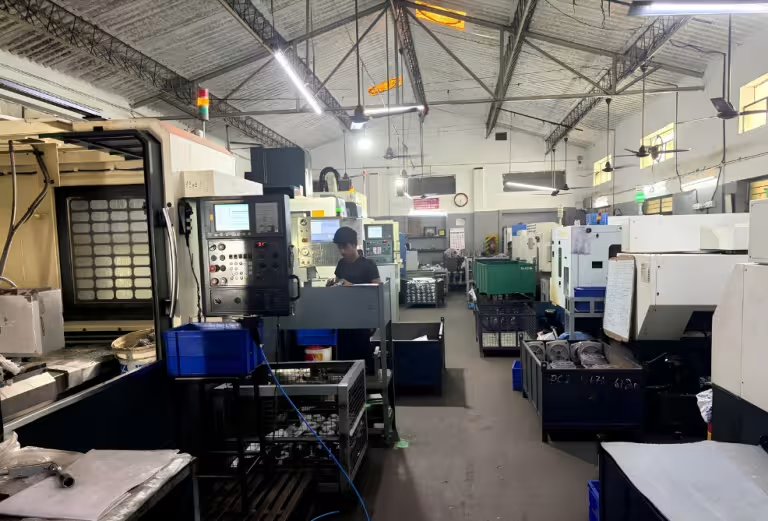
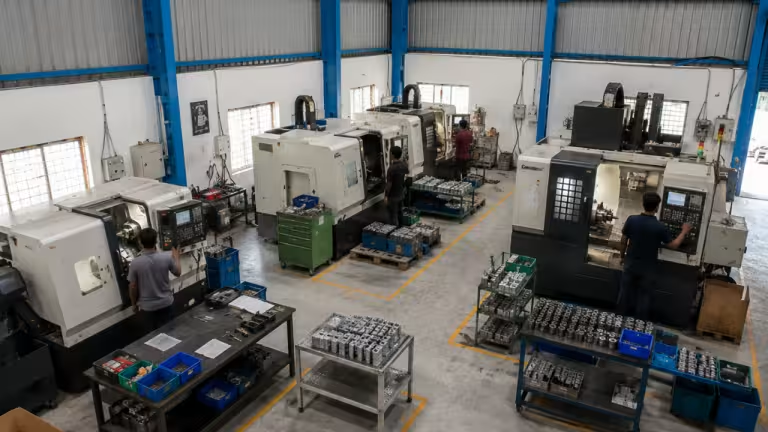
  • CNC machining operations including drilling, tapping, and slotting. 
  • Robotic welding and fabrication for structural assemblies. 
  • Multiple surface finishing options like anodizing and powder coating. 
  • Automated quality inspection systems ensure dimensional consistency. 
Can Frigate deliver fully machined and ready-to-assemble aluminum profile components?
  • Frigate offers complete value-added machining services beyond extrusion. 
  • Profiles can include CNC-machined holes, slots, and threaded features. 
  • Components can be delivered as pre-fabricated structural kits. 
  • Dimensional inspection and tolerance checks are performed before dispatch. 
  • This approach helps reduce secondary processing for customers. 
How does Frigate ensure reliable supply for large industrial and infrastructure projects?
  • Scalable manufacturing capacity supports medium to high-volume orders. 
  • Structured supply planning ensures consistent raw material availability. 
  • Batch traceability and certification documentation maintained for each lot. 
  • Global logistics coordination supports on-time project delivery. 
  • Long-term partnerships supported through contract manufacturing agreements. 
What engineering support does Frigate provide during the product development stage?
  • Frigate provides design consultation for optimized profile performance. 
  • Engineers assist with load calculations and structural analysis. 
  • Guidance provided on alloy selection and surface treatments. 
  • Prototype runs and pilot production validate design performance. 
  • Continuous engineering collaboration ensures cost-efficient solutions.
Get Clarity with Our Manufacturing Insights

We'd love to Manufacture for you!

Submit the form below and our representative will be in touch shortly.

LOCATIONS

Registered Office

10-A, First Floor, V.V Complex, Prakash Nagar, Thiruverumbur, Trichy-620013, Tamil Nadu, India.

Operations Office

9/1, Poonthottam Nagar, Ramanandha Nagar, Saravanampatti, Coimbatore-641035, Tamil Nadu, India. ㅤ

Other Locations

GENERAL ENQUIRIES

Get Quote
Support All File Formats Including - STEP | STP | SLDPRT | STL | DXF | IPT | X_T | X_B | 3DXML | CATPART | PRT | SAT | 3MF | JT files

LOCATIONS

Registered Office

10-A, First Floor, V.V Complex, Prakash Nagar, Thiruverumbur, Trichy-620013, Tamil Nadu, India.

Operations Office

9/1, Poonthottam Nagar, Ramanandha Nagar, Saravanampatti, Coimbatore-641035, Tamil Nadu, India. ㅤ

Other Locations

GENERAL ENQUIRIES

Get Your Quote Now

New Get Quote form

Heavy-Duty Structural Aluminum Profile

Need reliable wires and cables for your next project? Get in touch with us today, and we’ll help you find exactly what you need!

Get Latest Price

Get Price Form

Heavy-Duty Structural Aluminum Profile

Need reliable Machining for your next project? Get in touch with us today, and we’ll help you find exactly what you need!

Get Latest Price

Get Price Form