Aluminum Roof Rail Section

Aluminum roof rail sections are a critical component in various industries, offering a blend of material properties that ensure reliability, efficiency, and longevity. These sections are designed and engineered with precision to solve specific technical challenges, especially in demanding environments. For buyers and engineers, understanding the key attributes of these sections is essential in choosing the right material that can meet both performance requirements and operational constraints. 

Materials

6061 and 6082 aluminum alloys, offering high strength, corrosion resistance.

Surface Finishes

Available in anodized, powder-coated, or mill finish, depending on application.

Compliance Standards

Conforms to ASTM B221, EN 755-9, and ISO 9001:2015 quality management standards.

Cross-Section Area (A)

Ranges from 50-200 cm² depending on profile size and design configuration.

Mass per Meter (m)

Varies from 0.5 – 3.5 kg/m based on geometry, profile, and material thickness.

Product Description

Aluminum alloys used in roof rail sections are carefully selected for their superior strength-to-weight ratio. This characteristic is critical in applications where the structural component must support significant loads while minimizing the overall weight. In automotive and aerospace industries, weight reduction is directly linked to fuel efficiency and performance. Aluminum, with its low density compared to steel or other metals, provides the strength needed to withstand dynamic forces and environmental stress, while reducing the mass of the structure. 

Moment of Inertia (Ix / Iy)

From 1.2–35 cm⁴ (vertical) / 1.5–40 cm⁴ (horizontal), depending on rail design and application.

Section Modulus (Zx / Zy)

Between 1.0 – 10.0 cm³, affecting flexural strength of rail section under load.

Radius of Gyration (ix / iy)

Ranges from 1.0 – 3.0 cm, indicating structural stability under axial load.

Max. Axial Load (Euler Buckling)

Capacity ranges from 5 – 50 kN based on rail profile and length, buckling resistance.

Max. Load at Slot (Shear Test)

Maximum shear resistance varies from 1 – 15 kN, ensuring secure fastening under stress.

Torsional Constant (J)

Ranges from 2.0 – 150 cm⁶ depending on geometry, providing resistance to twisting.

Max Torque (Torsional Load Limit)

Limits range from 5 – 200 Nm, ensuring torsional strength and stability.

Elastic Deflection (100 N Load)

Typically ≤ 2 mm, ensuring minimal flex under 100 N applied load across spans.

Dynamic Load Rating

Ratings range from 10⁴ – 10⁶ cycles, indicating fatigue resistance in dynamic conditions.

Compatibility Tolerance

Tolerance of ± 0.2 mm for perfect fit with mating sections during assembly.

Machining Precision Grade

Meets ISO 2768-1 general tolerances for high-precision manufacturing standards.

Fatigue Life (Slot Edge)

Can withstand between 10⁶ – 10⁸ cycles based on slot edge design and usage.

Thermal Expansion (ΔL @ ΔT=50°C)

Exhibits a thermal expansion of 0.022 mm/m°C, important for temperature-sensitive applications.

Slot Pull-Out Resistance

Pull-out resistance varies from 5 – 50 kN, ensuring secure, reliable fastening.

Max Load Bearing at Corner Joint

Corner joints can bear from 5 – 50 kN, depending on design and material.

Technical Advantages

Aluminum is known for its excellent corrosion resistance, which is crucial for roof rail sections exposed to environmental elements. The formation of a natural oxide layer on aluminum surfaces acts as a protective barrier against oxidation and corrosion, even in harsh climates with high humidity or salt exposure. This property is vital for industries like automotive, rail transport, and construction, where parts are subjected to outdoor conditions or continuous moisture. In the case of aluminum roof rails, this corrosion resistance translates into extended service life with minimal maintenance costs.  

The manufacturing process of aluminum roof rail sections involves high-precision techniques to meet stringent dimensional tolerances. CNC machining, extrusion, and die-casting are commonly employed methods that ensure the components adhere to the required specifications with minimal deviation. This precision is vital when parts must fit within complex assemblies or conform to strict regulatory standards. For example, when aluminum roof rails are used in automotive designs, the exact measurements are critical for ensuring proper alignment and load distribution.  
Let's Get Started

Need reliable Extrusion for your next project? Get in touch with us today, and we’ll help you find exactly what you need!

Industry Applications

Automotive Roof Rail Systems

Aluminum roof rail sections provide lightweight structural support for roof racks and vehicle load-bearing systems, enhancing performance. 

Aerospace Fuselage Supports

Used for structural integrity in aircraft, aluminum sections withstand stress while maintaining low weight, crucial for fuel efficiency. 

Rail Transport Roofing

Aluminum roof rails provide durable, corrosion-resistant structural support for train carriages, ensuring stability under harsh environmental conditions. 

Construction Roof Framing

Used in commercial and residential roofing systems, aluminum rails offer strength and corrosion resistance for long-lasting, weatherproof structures. 

Solar Panel Mounting Systems

Aluminum sections support solar panel arrays on rooftops, providing strength and corrosion resistance for durable energy solutions. 

Industrial Warehouse Roofing

Roof rail sections in warehouses deliver robust support for large spans, ensuring safety and structural stability under heavy loads. 

Customization for Complex Design Requirements

Aluminum roof rail sections can be highly customized to accommodate specific design parameters. This includes adjusting the alloy composition for enhanced performance, varying the cross-sectional geometry to meet load distribution needs, or incorporating features like thermal breaks or integrated fastening systems. 

Aluminum roof rail sections are typically produced using processes that enable high throughput and fast lead times. Extrusion and die-casting, for instance, are capable of producing large quantities of sections with consistent quality, enabling rapid fulfillment of orders in industries with tight project deadlines. 

Having Doubts? Our FAQ

Check all our Frequently Asked Question

What aluminum alloys are typically used for roof rail sections, and how do they affect performance?

Aluminum alloys like 6061 and 6082 are commonly used for roof rail sections. These alloys offer a balanced mix of strength, corrosion resistance, and workability. The presence of magnesium and silicon in these alloys enhances mechanical properties like tensile strength, fatigue resistance, and weldability, making them ideal for structural applications where durability and precision are critical. 

How does the extrusion process impact the dimensional accuracy and strength of aluminum roof rail sections?

The extrusion process ensures consistent cross-sectional shapes and precise dimensional tolerances in aluminum roof rail sections. By controlling the cooling and extrusion speeds, manufacturers can optimize grain structure and mechanical properties, minimizing defects like warping or dimensional variations. This process results in highly accurate sections with superior strength, tailored for specific load-bearing requirements. 

How does anodizing aluminum roof rail sections enhance their performance in harsh environments?

Anodizing creates a protective oxide layer on aluminum, improving its resistance to corrosion, especially in marine, high-humidity, or chemically aggressive environments. This process increases wear resistance and prevents oxidation, making anodized aluminum roof rail sections ideal for applications exposed to extreme weather, such as automotive, rail transport, or construction in coastal areas. 

What is the role of fatigue resistance in aluminum roof rail sections used in dynamic applications like vehicles?

Fatigue resistance in aluminum roof rail sections is critical for dynamic applications where the material undergoes repeated loading cycles, such as in automotive or rail transport. By selecting high-strength alloys and optimizing the heat treatment process, the material can resist crack initiation and propagation under fluctuating stress, ensuring long-term structural integrity and minimizing failure risk over time. 

How does the low thermal conductivity of aluminum benefit roof rail sections in temperature-sensitive applications?

Aluminum’s low thermal conductivity helps regulate temperature in applications like solar panel mounting or roofing systems for temperature-sensitive equipment. It reduces heat transfer through the roof rail, providing better insulation properties. In automotive or aerospace applications, this minimizes the heat load on the structure, contributing to thermal efficiency and preventing material degradation under extreme temperature fluctuations.

Why should buyers source aluminum roof rail sections directly from Frigate as a manufacturer?
  • Direct manufacturing control ensures consistent quality and dimensional accuracy. 
  • Custom extrusion capabilities for application-specific rail profiles. 
  • Engineering support for optimizing load capacity and structural performance. 
  • Reliable production timelines for time-sensitive industrial projects. 
Can Frigate manufacture custom aluminum roof rail profiles for specific applications?
  • Custom extrusion based on customer drawings or CAD designs. 
  • Support for alloy selection such as 6061 or 6082. 
  • Integration of slots, ribs, and mounting channels as required. 
  • Prototype or small-batch production before mass manufacturing. 
  • Engineering validation to ensure structural performance and compatibility. 
What value-added manufacturing services does Frigate provide for aluminum roof rail sections?
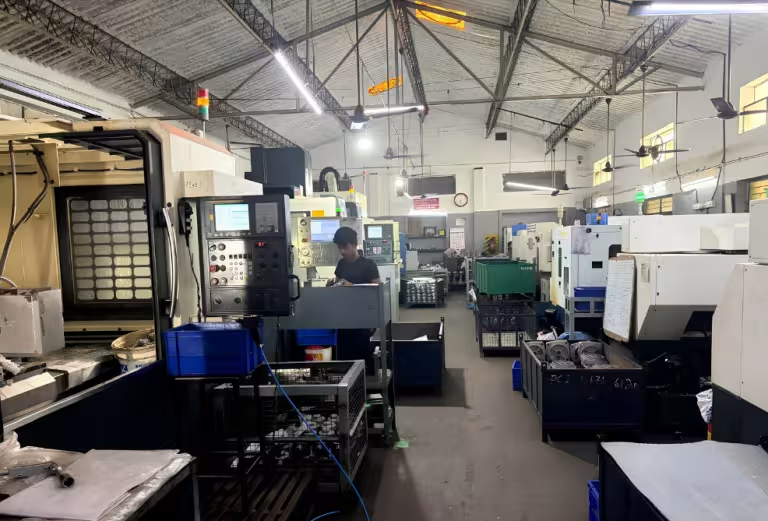
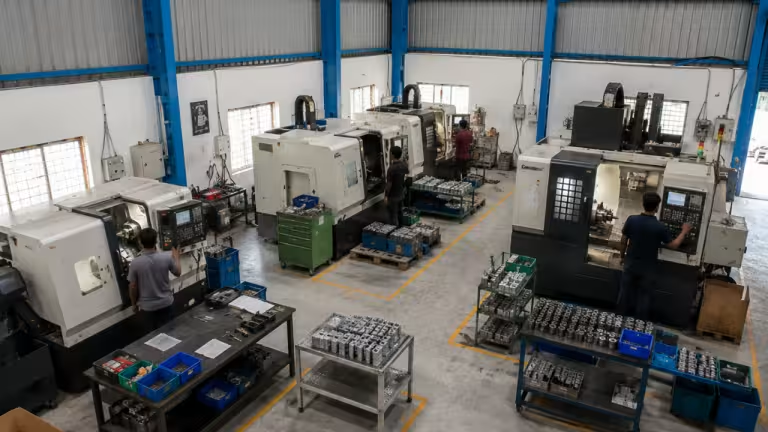
  • Precision CNC machining for slots, holes, and mounting features. 
  • Tight tolerance machining for complex assemblies. 
  • Optional pre-assembly of components. 
  • Secure packaging and logistics support for industrial delivery. 
How does Frigate ensure consistent quality in large-volume roof rail production?
  • Advanced extrusion and machining equipment for repeatable accuracy. 
  • Material traceability and alloy verification. 
  • Dimensional inspection and mechanical testing during production. 
  • Batch-level quality documentation for procurement compliance. 
  • Continuous process monitoring for consistent product performance. 
How can procurement teams work with Frigate to request a quotation for aluminum roof rail sections?
  • Share technical drawings or profile specifications. 
  • Define alloy, finish, and tolerance requirements. 
  • Specify required quantities and delivery timelines. 
  • Frigate’s engineering team reviews the design for manufacturability. 
  • Receive a detailed quotation with production scope and lead time. 
Get Clarity with Our Manufacturing Insights

We'd love to Manufacture for you!

Submit the form below and our representative will be in touch shortly.

LOCATIONS

Registered Office

10-A, First Floor, V.V Complex, Prakash Nagar, Thiruverumbur, Trichy-620013, Tamil Nadu, India.

Operations Office

9/1, Poonthottam Nagar, Ramanandha Nagar, Saravanampatti, Coimbatore-641035, Tamil Nadu, India. ㅤ

Other Locations

GENERAL ENQUIRIES

Get Quote
Support All File Formats Including - STEP | STP | SLDPRT | STL | DXF | IPT | X_T | X_B | 3DXML | CATPART | PRT | SAT | 3MF | JT files

LOCATIONS

Registered Office

10-A, First Floor, V.V Complex, Prakash Nagar, Thiruverumbur, Trichy-620013, Tamil Nadu, India.

Operations Office

9/1, Poonthottam Nagar, Ramanandha Nagar, Saravanampatti, Coimbatore-641035, Tamil Nadu, India. ㅤ

Other Locations

GENERAL ENQUIRIES

Get Your Quote Now

New Get Quote form

Aluminum Roof Rail Section

Need reliable wires and cables for your next project? Get in touch with us today, and we’ll help you find exactly what you need!

Get Latest Price

Get Price Form

Aluminum Roof Rail Section

Need reliable Machining for your next project? Get in touch with us today, and we’ll help you find exactly what you need!

Get Latest Price

Get Price Form