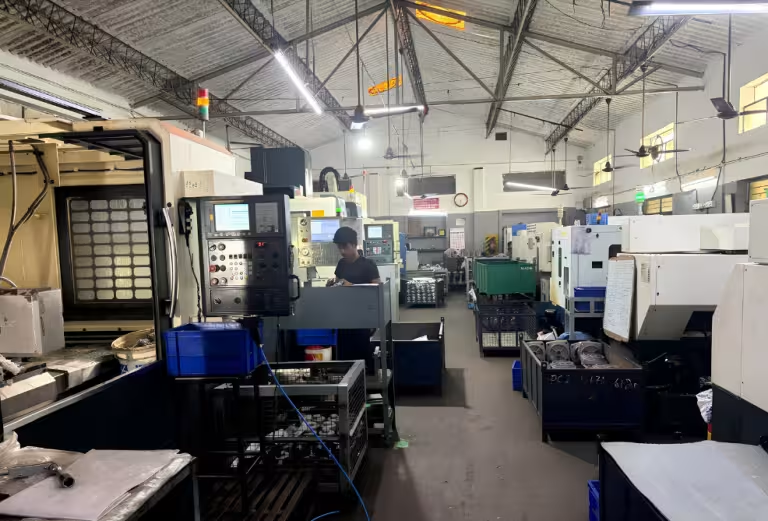

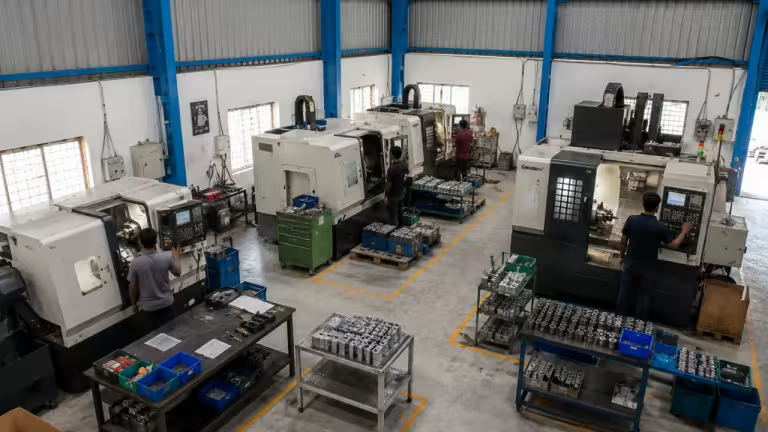







CNC machining parts drive precision across industries—from satellites to surgical tools. High precision machined components are engineered to exact tolerances, often operating in critical assemblies where failure is not an option. But behind every CNC component lies a structured lifecycle. Each phase—raw material, engineering, machining, finishing—contributes to part quality, traceability, and performance.
Recent data from the Journal of Manufacturing Processes shows that over 65% of downstream part failures originate from early-stage oversights—material inconsistencies, unoptimized toolpaths, or poor DFM (Design for Manufacturability). This blog breaks down the CNC Parts lifecycle and showcases how Frigate eliminates failure points through full-spectrum machining quality control.

Lifecycle of CNC Parts
Understanding the CNC parts lifecycle is essential to producing custom CNC components that meet strict quality standards. Each phase is critical in ensuring dimensional accuracy, material reliability, and functional durability. Below is a detailed breakdown of the CNC parts lifecycle, from raw material to finished product.
Material Intelligence and Strategic Sourcing
The very first step in CNC Part manufacturing is choosing the right material. This decision affects everything—from machinability and structural strength to corrosion resistance and weight. Common materials like 6061-T6 aluminum, 316 stainless steel, and Ti-6Al-4V titanium are selected based on the intended performance of the machined CNC parts.
But using certified materials isn’t enough. Many failures stem from material non-compliance, such as residual stresses or inconsistent grain structures that only occur during or after machining.
To prevent this, Frigate applies a strict sourcing and validation protocol, which includes –
- Spectrometric material analysis to confirm alloy composition
- Heat lot certifications verifying the thermal treatment of materials
- Microstructural integrity mapping to assess grain consistency and detect internal flaws
Only materials from NADCAP or ISO 17025-certified mills are approved. Each batch is digitally linked to the part through Frigate’s ERP system, ensuring full traceability from the raw bars to the machined CNC parts.
Engineering Validation and Digital Twin Alignment
A detailed 3D CAD model is insufficient to guarantee a part is manufacturable. Features like internal cavities, tight corners, or complex geometries can be difficult or impossible to machine without thorough validation.
Frigate eliminates this risk through digital twin simulations—virtual models that mirror real-world behavior under machining conditions.
Key tools include –
- Toolpath accessibility modeling to ensure cutting tools can reach all surfaces
- Virtual strain and deformation analysis to detect areas of potential warping
- Thermal behavior mapping under real-time spindle and load conditions
This process ensures zero disconnect between the design intent and machining reality. It also cuts design-to-manufacturing errors by up to 40%.

Process Planning and Predictive CAM Programming
Once the design is validated, it’s converted into a toolpath using CAM (Computer-Aided Manufacturing) software. However, not all CAM strategies are equal.
In precision CNC machining services, inefficient toolpaths like improper ramp angles or incorrect feed rates—can lead to tool wear, poor finishes, and increased machining time
Frigate avoids these pitfalls using –
- Predictive CAM platforms that simulate tool behavior under real conditions
- Live spindle load monitoring to track stress on tools in real time
- Tool deflection control algorithms to maintain dimensional accuracy
CAM logic for high-precision machining components is adapted to suit each material type and geometry class This reduces unnecessary tool changes, improves cycle efficiency, and extends tool life by 25%, leading to cost savings and improved consistency.
High-Fidelity Subtractive Manufacturing
This is the heart of cnc parts production—where raw metal is milled, drilled, and turned into final shapes with sub-micron precision. However, errors during this stage can be costly, hard to fix and collapse the entire CNC parts lifecycle.
Frigate relies on –
- Advanced 5-axis CNC machining services centers for maximum geometry flexibility
- Thermal compensation sensors that auto-correct for heat expansion
- Real-time machine diagnostics that detect vibration, tool wear, and positional drift
With all these systems in place, even the slightest deviations—like a 10 µm variation—are detected and corrected automatically. The result is a highly repeatable manufacturing process that delivers machined components within exact GD&T 21.
Multi-Layer Quality Governance
Inspecting parts only after production is too late. By then, defective parts may already be scrapped, wasting time and material.
Frigate instead integrates multi-stage quality control into every phase –
- Optical sensors and in-situ probes used in our precision CNC machining services to check dimensions during production
- Statistical Process Control (SPC) tools monitor process variation in real-time
- Coordinate Measuring Machines (CMMs) validate final geometry
Final inspection includes –
- Surface roughness evaluation (Ra values)
- First Article Inspection (FAI) for initial production runs
- Full traceability reports linked to ERP and serialized barcodes
This ensures custom CNC components meet dimensional standards and is backed by verifiable data at every stage.
Functional Enhancement through Surface Engineering
Even perfectly machined CNC parts can fail in the field if the surface isn’t engineered for its environment. Frigate applies custom surface treatments tailored to performance needs.
Treatment options include –
- Hard anodizing (Type III) for wear resistance in moving parts
- Nickel electroplating for corrosion protection in marine or chemical exposure
- Ceramic thermal barrier coatings for aerospace and high-temperature components
Every coating undergoes strict validation –
- Adhesion pull testing for bonding strength
- Salt spray testing (ASTM B117) for corrosion resistance
- Microhardness mapping for wear and fatigue durability
These enhancements extend part life by 40% or more in demanding environments.

Logistics Optimization and Serialized Product Release
The final stage—logistics—might seem routine, but poor handling can cause custom CNC components to lose tolerance or suffer cosmetic and functional damage.
Frigate’s precision CNC machining services treat packaging and delivery as part of the engineering process –
- Anti-static and shock-resistant materials protect delicate surfaces
- Vacuum sealing prevents oxidation of sensitive alloys
- Digital serialization tracks each part’s history and compliance data
Each part is shipped with a digital birth record, including –
- Material certifications
- Quality inspection results
- Assembly compliance documentation
This system enables full traceability, ensures regulatory compliance, and supports rapid recall or service tracking when needed.
Strategies for High-Quality CNC Machined Parts
Producing high precision machining parts consistently and efficiently requires more than advanced machines. It demands a strategic integration of design, manufacturing intelligence, quality assurance, and digital infrastructure. Below are Frigate’s key strategies to ensure unmatched quality and traceability.
Vertical Integration and Digital Thread Continuity
A common challenge in CNC Part manufacturing is the fragmentation of information across departments and systems. This disconnection often leads to delays, data silos, miscommunication, and quality escapes in precision CNC components production.
Frigate solves this through vertical integration supported by a continuous digital thread—a single, unbroken data flow from initial design to final delivery. This includes –
- CAD/CAM data integration for seamless design-to-manufacture transition
- Machine telemetry feeds capturing spindle loads, tool paths, and machine diagnostics
- In-line quality control data tied to each machining operation
- Inventory and shipment logs integrated with ERP and MES systems
If CNC machined parts fail inspection, the system instantly traces it back to specific parameters—such as material heat batch, toolpath configuration, operator shift, or even ambient shop conditions during machining. This traceability significantly enhances root cause analysis and corrective actions.
Proactive Design-Manufacturing Convergence
Design changes introduced late in the production cycle can cause tooling conflicts, process delays, and costly reworks. To minimize this, Frigate integrates manufacturing feedback early into the design stage.
This is achieved through –
- Design for Manufacturability (DFM) consultations involving engineers, machinists, and quality teams during the initial design phase
- Prototype development using soft tooling to validate form, fit, and function before full-scale production
- Functional simulations to test critical dimensions, assembly clearances, and performance under load before any metal is cut
This early collaboration reduces the need for Engineering Change Orders (ECOs), leading to 15–20% faster development cycles, ensuring that designs are machinable and production-ready.
Machine Learning-Enhanced Toolpath Strategy
Traditional CAM systems rely on static toolpath libraries, often failing to optimize cutting for complex geometries or challenging materials in custom CNC parts production.
Frigate enhances CAM programming with machine learning (ML) models trained on years of historical machining data. These models dynamically optimize –
- Entry and exit strategies for intricate contours and variable wall thicknesses
- Spindle speed and feed rate adjustments specific to alloy behavior and cutting tool condition
- Tool engagement depths calculated from past wear profiles and cycle completion rates
This ML-enhanced strategy results in –
- Surface finishes below Ra 0.8 µm, ideal for aerospace, optics, and sealing surfaces
- Reduced tool wear and breakage, increasing tool longevity and minimizing unplanned downtime
- Improved material utilization, especially for expensive alloys like titanium and Inconel
Closed-Loop Quality Feedback Systems
In traditional CNC processes, inspection typically happens after machining is complete—by which any defects have already consumed time and resources. Frigate avoids this by implementing closed-loop quality control systems.
This system includes –
- In-machine probing systems to check critical dimensions mid-cycle
- Laser edge scanners that monitor geometry and toolpath deviations in real time
- Auto-calibrated tool offsets that self-adjust based on probe or scanner feedback
These technologies enable the machine to adapt quickly, correcting for tool wear, thermal drift, or fixture misalignment. The result is a first-pass yield rate of 98.7%, meaning nearly every part meets specifications on the first attempt—saving both material and machining hours.
Advanced Surface Engineering Stack
Even with perfect dimensions, CNC parts must perform in real-world environments—where friction, corrosion, fatigue, and temperature can degrade functionality. Frigate offers a comprehensive surface engineering stack that enhances durability, resistance, and lifespan.
Common treatments include –
- Diamond-like carbon (DLC) coatings for low-friction and high-load applications like actuators or sliding assemblies
- Multi-layer nickel-tin overlays for corrosion resistance in marine and chemical processing environments
- Multi-axis shot peening for aerospace high-precision CNC parts, improving fatigue resistance and surface stress distribution
Each coating or treatment is tested using –
- Microcrack resistance analysis under cyclic loads
- Fatigue life testing using high-cycle stress protocols
- Coating adhesion validation through ASTM and MIL-STD testing procedures
These machining quality control ensures that each part performs consistently—long after installation and under extreme operational conditions.
Supply Chain Synchronization and Batch-Level Intelligence
Disruptions in supply chain data—such as misidentified parts, lost records, or unclear origin—can severely affect downstream operations like assembly, compliance audits, and service maintenance.
Frigate addresses this with lot-level serialization and intelligent part tracking enabled by cloud-connected systems. Each CNC part is –
- Digitally mapped from billet to shipment, capturing every material, tool, and process touchpoint
- Assigned a unique ID that links it to all quality and process data (material certs, inspection reports, machine logs)
- Stored in a cloud-based part registry, which customers can access for audits, compliance, or product lifecycle planning
This ensures that CNC parts are not just dimensionally accurate but also intelligently connected—supporting real-time traceability, predictive maintenance, and seamless integration into modern Industry 4.0 environments.
Conclusion
CNC Parts aren’t just machined—they’re engineered, validated, and managed across their entire lifecycle. Each phase influences the final part’s performance and reliability, from metallurgical sourcing to advanced coatings and serialized delivery.
Frigate goes beyond basic machining. It delivers high-integrity CNC Parts through a connected, intelligent manufacturing ecosystem. If precision, quality, and traceability matter to your operations—Get Instant Quote with Frigate. We help scale your CNC machining parts production without compromise.