





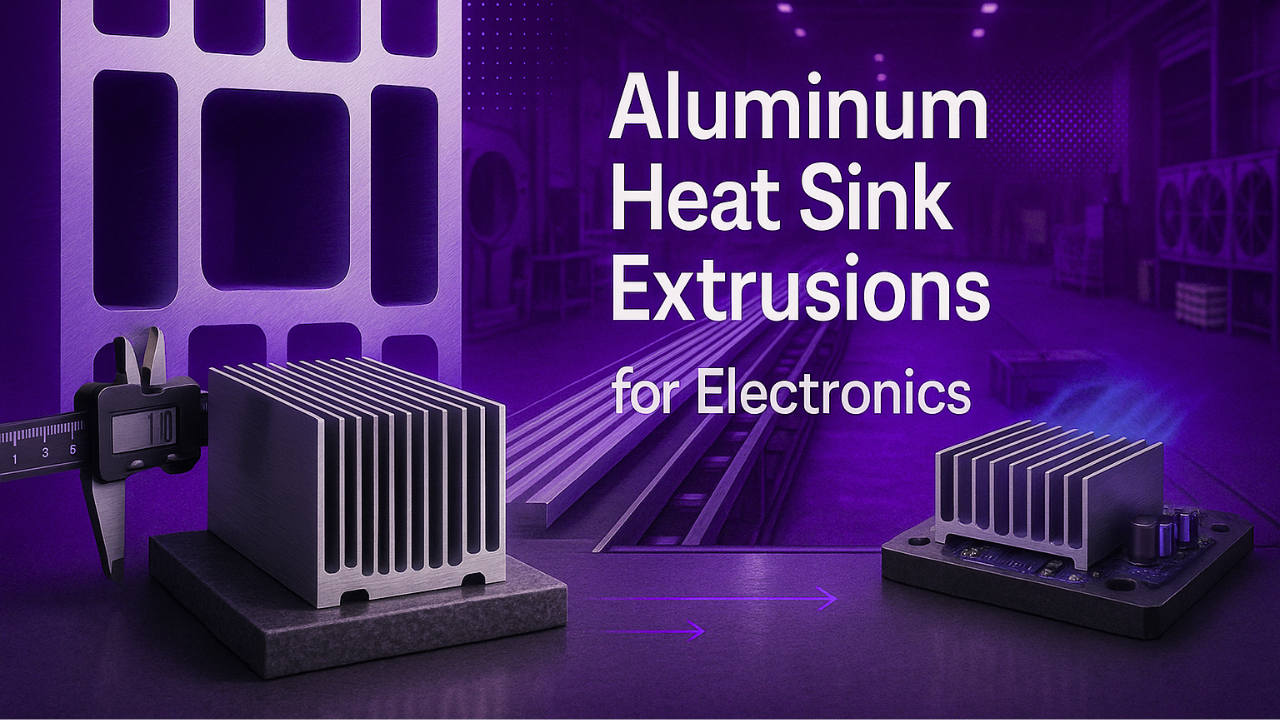
Thermal control has become one of the most critical parameters in electronic design today. Modern devices operate at higher frequencies, denser power loads, and smaller footprints—conditions that generate more heat per unit area. When that heat is not managed efficiently, it can cause temperature spikes, degraded performance, and even system failure.
Reports from the electronics reliability sector indicate that more than half of electronic component failures are linked to overheating. The role of Aluminum Heat Sink Extrusions for Electronics is therefore vital to maintain stable thermal equilibrium across components.
A technically optimized heat sink improves power density, extends service life, and minimizes maintenance interruptions. However, several sourcing challenges—ranging from alloy inconsistency to inaccurate extrusion geometry—can compromise these advantages. Choosing a reliable extrusion sourcing partner is not simply a procurement decision; it is an engineering assurance that determines overall thermal reliability and lifecycle performance.
What to Consider While Sourcing Aluminum Heat Sink Extrusions for Electronics?
Choosing Aluminum Heat Sink Extrusions for Electronics requires careful attention to thermal performance, dimensional accuracy, and material consistency. Even small deviations in alloy composition or fin design can cause heat buildup and reduce component life. A reliable sourcing approach should emphasize extrusion precision, controlled alloy properties, and stable surface finishes to ensure consistent heat dissipation and long-term reliability.
Alloy Design Intelligence and Thermal Path Optimization
Thermal performance begins at the alloy stage. The microstructural behavior of aluminum alloys such as 6063 and 6061 defines both thermal conductivity and mechanical stability. The thermal conductivity of pure aluminum can reach 235 W/m·K, but deviations in alloy ratios may reduce that value significantly.
Alloy composition must therefore be balanced for conductivity, strength, and manufacturability. Controlled homogenization before extrusion ensures uniform grain size and consistent heat flow throughout the profile. The result is stable temperature gradients across the heat sink surface, which is essential for power modules, LED housings, and compact enclosures.
Advanced sourcing practices now rely on metallurgical simulations to forecast grain orientation and heat transfer paths before extrusion. This predictive approach minimizes performance losses and aligns material behavior with design intent.
Precision Geometry and Functional Integration
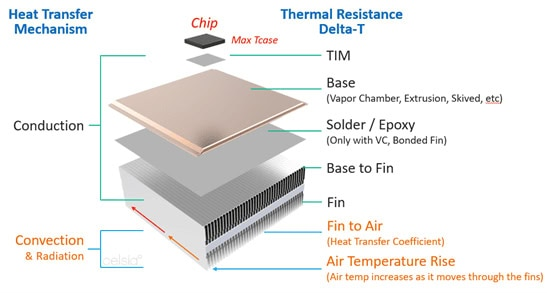
Geometry governs how efficiently a heat sink dissipates heat. Fin spacing, wall thickness, and surface area define airflow and convective efficiency.
Topology-optimized extrusion profiles can achieve up to 25% higher surface exposure while maintaining low weight. These designs enhance heat transfer without adding material cost or mass. Complex geometries may also integrate mounting channels, EMI barriers, or fastening points directly into the extrusion body, reducing assembly time and tolerance stacking errors.
Dimensional accuracy must remain within microns; even a 0.2 mm variation in fin thickness can alter pressure distribution or mounting contact, increasing thermal resistance. Tight die control and stable extrusion parameters are therefore critical to achieve uniform cross-sectional geometry.
Process Control in Extrusion and Post-Treatment
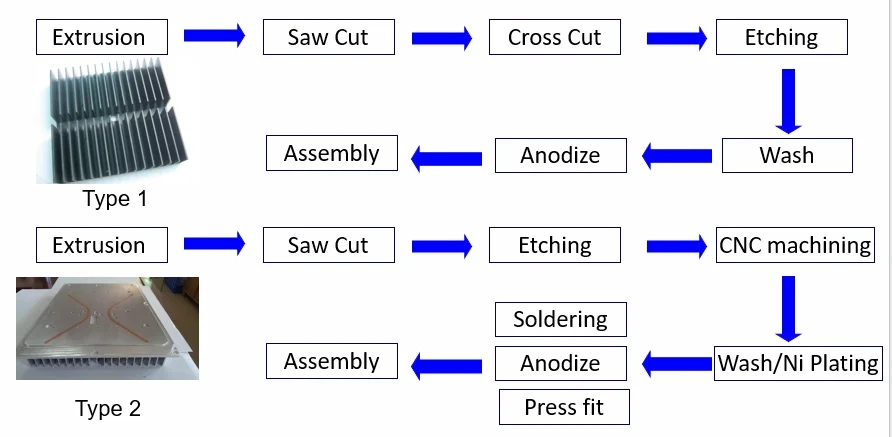
Extrusion performance depends heavily on process consistency. Temperature, ram speed, and extrusion pressure must be synchronized precisely to maintain uniform metal flow. Excessive temperature softens the alloy and leads to dimensional drift, while insufficient heat creates cracks or voids.
A balanced process ensures controlled metal deformation and maintains density throughout the section. Immediate quenching stabilizes grain structure and prevents unwanted phase separation. Post-extrusion treatments, such as artificial aging, refine hardness and machinability—important for post-processing like drilling, tapping, and milling.
Sourcing partners equipped with closed-loop process monitoring systems can maintain extrusion uniformity within strict tolerance bands and achieve predictable performance over multiple production batches.
Surface Engineering for Enhanced Thermal and Electrical Performance
Surface finishing has a direct impact on the heat sink’s ability to release energy. Anodizing not only improves corrosion resistance but also enhances emissivity, which increases radiative heat transfer. A standard black anodized finish can elevate emissivity levels from 0.1 to approximately 0.85, leading to significantly improved cooling efficiency.
Special coatings such as plasma or PVD films provide electrical isolation in high-voltage systems while retaining thermal conductivity. Controlled surface roughness, typically maintained below Ra 1.6 µm, ensures proper thermal interface bonding and reduces air gap formation between the surface and thermal pads.
Surface engineering must therefore be treated as a functional specification rather than a cosmetic requirement when sourcing Aluminum Heat Sink Extrusions for Electronics.
Qualification Metrics and Compliance Framework
Performance validation of heat sink extrusions requires adherence to recognized industry standards. Specifications such as ASTM B221 for dimensional control and ISO 2768 for geometric tolerance compliance are fundamental benchmarks.
Quality testing extends to salt spray resistance, thermal cycling, and humidity exposure, ensuring corrosion resilience and structural integrity. For telecom, automotive, or outdoor power applications, verification under IEC 60068 environmental test conditions confirms long-term durability.
Sourcing frameworks must also include full traceability documentation—chemical certificates, mechanical test results, and coating analysis. Lack of traceability increases the risk of non-compliance and undermines system reliability.
Supplier Ecosystem Maturity and Technology Readiness
A technically mature supplier ecosystem minimizes risk and ensures repeatable outcomes. Extrusion presses should operate with calibrated load control, uniform billet heating, and integrated die monitoring.
Advanced suppliers use thermal flow simulation tools to predict material behavior through complex dies. This capability reduces trial iterations, shortens lead times, and ensures precision extrusion across production runs.
Global electronics manufacturing often depends on consistent sourcing performance. Geographically fragmented supply chains introduce variability in alloy sourcing, temperature control, and surface treatment quality. Centralized and technology-driven suppliers, such as Frigate, ensure uniformity through digitally integrated production monitoring and end-to-end material control.
Lifecycle Cost Modeling and Performance Economics
Cost evaluation in heat sink sourcing extends beyond initial procurement price. True cost efficiency derives from the thermal performance-to-cost ratio across the component’s lifecycle.
A heat sink that reduces junction temperature by just 5°C can extend semiconductor lifespan by up to 50%, translating directly into lower maintenance and replacement expenses. Optimized die design, efficient extrusion flow, and higher yield rates reduce material waste and total cost of ownership.
Suppliers that leverage simulation-backed cost analysis deliver both economic and technical clarity, enabling sourcing decisions based on performance metrics rather than short-term pricing.
How Frigate Ensures Technical Precision and Reliability in Aluminum Heat Sink Extrusion Sourcing?
Delivering reliable Aluminum Heat Sink Extrusions for Electronics demands control across every production variable — from alloy purity to logistics traceability. Process instability, even at micro-levels, can alter thermal conductivity, cause geometric deviation, and reduce long-term system reliability. Frigate applies a fully integrated, data-driven framework that connects metallurgical validation, digital process modeling, and predictive analytics to maintain dimensional accuracy, consistent heat transfer, and supply stability across every production cycle.
Metallurgical Process Governance and Data-Driven Alloy Selection
Every Aluminum Heat Sink Extrusion for Electronics begins with metallurgically governed billet preparation. Frigate follows a closed-loop metallurgical validation process that monitors impurity levels, intermetallic phase distribution, and grain boundary morphology using spectral emission analysis and scanning electron microscopy (SEM). Controlled homogenization treatments stabilize microstructure and prevent segregation, ensuring uniform flow during extrusion.
Advanced data models map correlations between alloying elements—particularly silicon, magnesium, and copper—and their impact on thermal conductivity, mechanical strength, and extrusion speed. Predictive analytics help maintain a constant λ (thermal conductivity coefficient) and tensile modulus across multiple batches. This data-driven governance reduces batch variability, maintaining consistent thermal resistance and mechanical reliability for electronic cooling assemblies, inverters, and power conversion units.
Digital Twin-Based Extrusion Design and Validation
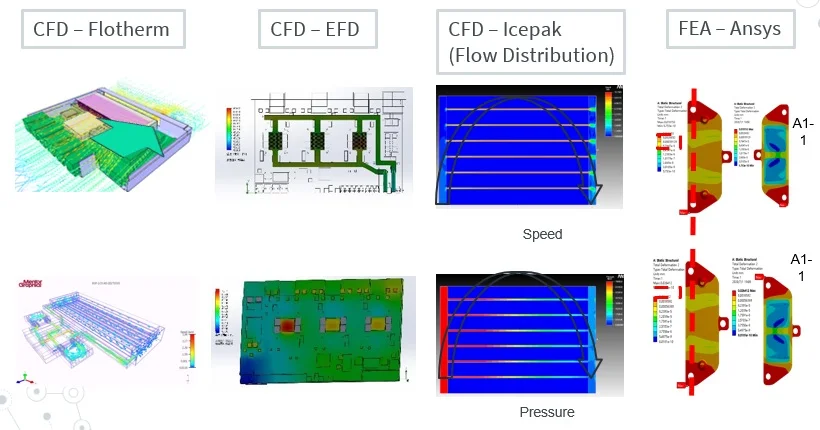
Before tooling, Frigate applies digital twin modeling to create a virtual replica of the extrusion process. This simulation evaluates metal flow velocity, pressure gradients, and fin geometry fidelity under varying die temperatures and extrusion speeds. Computational Fluid Dynamics (CFD) and Finite Element Analysis (FEA) models assess die behavior, reducing hotspots and back-pressure zones that commonly lead to dimensional distortion.
By validating the geometry virtually, extrusion tooling is manufactured with fewer iterations, lowering both die fatigue and rework time. The approach ensures that fin density, base thickness, and airflow channels perform as designed, maintaining uniform temperature distribution when the heat sink operates under high-load conditions. Such modeling provides predictive precision, ensuring every Aluminum Heat Sink Extrusion for Electronics conforms to required performance envelopes before physical production begins.
Controlled Surface Engineering and Thermal Characterization
Frigate maintains strict process control during surface anodization and coating to enhance emissivity and corrosion resistance. Each anodic cell is monitored for electrolyte concentration, bath temperature, and voltage waveform stability. Pulse anodization ensures deeper oxide penetration and micro-porous film uniformity.
Thermal behavior of anodized surfaces is validated using laser flash analysis to determine diffusivity (α) and infrared thermography to observe real-time heat propagation across complex fin arrays. Emissivity coefficients (ε) are tracked digitally for every batch, ensuring each extrusion maintains consistent radiant heat dissipation. All process data, including oxide thickness, thermal conductivity, and reflectivity, is archived in a traceable database for quality audits and future performance optimization.
Multi-Stage Inspection and Predictive Quality Analytics
Precision inspection begins at the extrusion press, where high-speed optical scanners monitor die exit profiles in real time. Each profile is validated through Coordinate Measuring Machines (CMM) capable of sub-micron measurement accuracy. Profilometry is applied to confirm surface flatness and fin parallelism within ±0.01 mm tolerance.
Thermal imaging is conducted during simulated electronic load testing to verify temperature uniformity across fins. Predictive analytics software continuously evaluates extrusion pressure data, billet temperature variance, and hydraulic synchronization to forecast potential deviation trends. Early anomaly detection triggers automated process correction, minimizing rejection rates. This quality intelligence ensures every Aluminum Heat Sink Extrusion for Electronics meets mechanical and thermal repeatability standards demanded by mission-critical applications.
Integrated Logistics and Agile Sourcing Framework
Frigate’s production ecosystem integrates real-time manufacturing execution with enterprise logistics management. Each extrusion batch is digitally tracked from billet casting to final shipment using barcode and RFID traceability. ERP-linked process nodes synchronize die maintenance, press scheduling, and heat treatment cycles for complete supply transparency.
This integration enables predictive scheduling, reducing downtime and ensuring rapid changeovers between extrusion profiles. Agile sourcing supports industries where product design iterations occur frequently—such as automotive electronics, industrial drives, and renewable energy systems—ensuring component availability aligns with prototype or production needs. Dynamic inventory buffering further prevents supply interruptions, maintaining lean yet reliable fulfillment for every order.
Sustainability-Linked Sourcing and Lifecycle Optimization
Sustainability and technical performance are treated as interdependent metrics at Frigate. The extrusion lines utilize low-carbon aluminum billets certified under ISO 14067 and employ recirculating water-cooled hydraulic systems to minimize energy loss. Process heat recovery units reuse thermal energy from billet preheating, reducing total energy intensity per ton of extrusion.
Each batch of Aluminum Heat Sink Extrusions for Electronics carries a sustainability dossier detailing billet origin, carbon footprint per kilogram, and energy utilization metrics. This data assists OEMs in ESG compliance reporting and lifecycle assessments. Long-term recyclability is built into the extrusion design—allowing re-melting without degradation in conductivity or mechanical performance—making each product both technically efficient and environmentally accountable.
Collaborative Engineering for Application-Specific Performance
Frigate’s co-engineering framework bridges design and manufacturing through digital collaboration platforms. OEM design teams share 3D models and simulation results directly with Frigate’s process engineers to co-optimize extrusion profiles for distinct operational environments.
Airflow velocity mapping, heat flux distribution, and electronic enclosure integration are analyzed simultaneously using multi-physics simulation tools. Prototype cells equipped with quick-exchange dies enable rapid validation of modified fin geometries and coating variations within days, not weeks.
This concurrent design approach ensures each Aluminum Heat Sink Extrusion for Electronics is precisely tuned for target thermal resistance (Rθ), weight optimization, and assembly compatibility. The result is a solution engineered for sustained performance under variable load cycles, shock, and ambient stress conditions across automotive, industrial automation, and energy infrastructure applications.
Conclusion
Effective thermal management defines the reliability and lifespan of modern electronic systems. High-quality Aluminum Heat Sink Extrusions for Electronics ensure optimal heat transfer, dimensional stability, and consistent performance under varying load and environmental conditions. Precision in alloy chemistry, extrusion tolerance, and surface treatment directly influences system efficiency and operational safety.
Frigate delivers technically validated extrusion solutions built on metallurgical control, digital simulation, and predictive quality analytics. Each profile is engineered for consistent thermal conductivity, mechanical strength, and sustainability compliance. For performance-driven and reliable Aluminum Heat Sink Extrusions for Electronics, connect with Frigate to discuss customized sourcing strategies tailored to demanding electronic applications.