





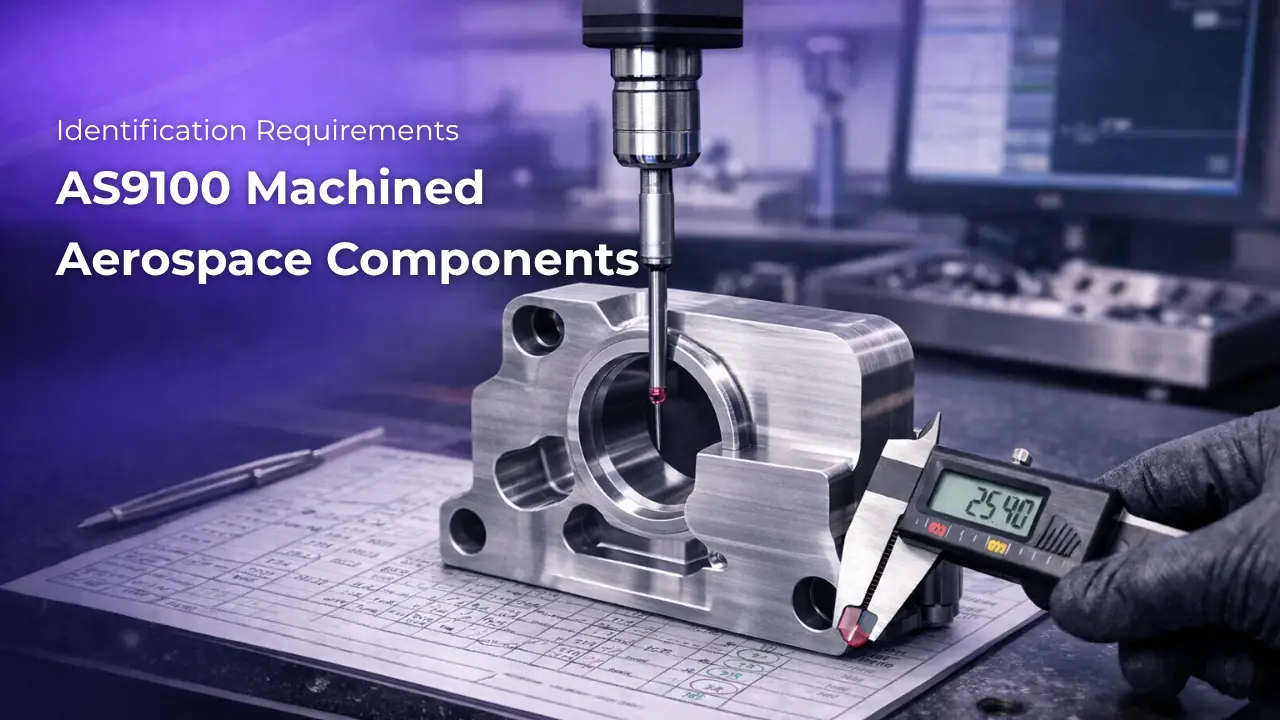
Aerospace manufacturing programs operate under strict control environments where every component must be identifiable, traceable, and compliant with defined specifications. Marking is not treated as a separate activity but as a critical production process that directly impacts inspection, documentation, and acceptance.
Machined aerospace components often involve complex geometries, high-value materials, and tight tolerances. Marking these parts requires precision, repeatability, and process control that aligns with manufacturing workflows. Any inconsistency in marking can lead to traceability gaps, inspection delays, or rejection during audits.
AS9100 aerospace part marking services are therefore executed as part of the manufacturing system, ensuring that identification is applied correctly from the first part through full-scale production. This approach ensures that marking supports production efficiency, compliance, and long-term traceability without affecting part performance.
Production-Integrated AS9100 Aerospace Part Marking Services for Machined Components
Production environments require marking processes that align with machining outputs, inspection checkpoints, and quality validation. AS9100 aerospace part marking services are implemented as an in-line operation to ensure that marking is applied with precision and consistency across all components.
Marking integrated within production eliminates unnecessary handling, reduces the risk of misidentification, and ensures that each part is marked according to defined specifications. This approach supports both prototype and volume production while maintaining repeatability.
Manufacturing-Driven Execution
- Marking aligned with CNC machining datums and reference features to ensure correct placement
- Controlled marking zones defined during process planning to avoid functional surfaces
- In-line marking reduces part movement and minimizes handling errors
- Synchronization with inspection processes ensures marking verification before release
- Repeatable parameter settings ensure uniform marking across batches
- Reduced mismatch risk between part identity and production records
This structured execution ensures that AS9100 aerospace part marking services deliver consistent, compliant, and production-ready results.
Aerospace Component Marking and Identification Solutions Designed for Throughput
High-performance manufacturing environments require marking systems that do not slow down production. Aerospace component marking and identification solutions are designed to support throughput while maintaining strict quality standards.
Marking processes must adapt to different part geometries, materials, and production volumes. Solutions are configured to ensure that identification remains clear, readable, and aligned with inspection requirements without creating bottlenecks.
Production Capabilities
- Direct part marking integrated with machining output ensures immediate identification
- Automated serialization reduces manual intervention and improves accuracy
- High-contrast marking improves inspection speed and readability
- Integration with ERP and production tracking systems ensures data consistency
- Capability to mark complex geometries without compromising accuracy
- Consistent marking output across multi-part and multi-batch production
These aerospace component marking and identification solutions support efficient production flow while maintaining compliance.
AS9100 Compliant Part Marking Suppliers with Full Manufacturing Control
Manufacturing environments benefit from complete control over marking processes. Working with AS9100 compliant part marking suppliers that rely on external processes often introduces variability and delays.
A manufacturing-controlled marking setup ensures that all parameters, validations, and outputs are aligned with production requirements. This reduces dependency on external vendors and improves overall process reliability.
What This Means for Your Production
- Single-point control over machining and marking ensures process alignment
- Elimination of third-party variability improves consistency
- Better control over delivery timelines and production schedules
- Process validation conducted before production ensures readiness
- Alignment with customer-specific marking requirements improves acceptance
- Consistent execution across batches and long-term programs
Choosing a manufacturing-driven approach instead of relying on external AS9100 compliant part marking suppliers improves control and reliability.
Permanent Marking Services for Aerospace Components Built for Lifecycle Reliability
Aerospace components operate under demanding conditions, requiring identification that remains intact throughout the lifecycle. Permanent marking services for aerospace components are designed to maintain clarity, durability, and resistance under operational stress.
Marking methods are selected based on material characteristics, application requirements, and environmental exposure. This ensures that marking does not degrade or become unreadable over time.
Engineering-Focused Approach
- Material-specific parameter selection ensures compatibility with aerospace alloys
- Controlled marking depth prevents structural impact on critical components
- High resistance to wear, corrosion, and environmental exposure
- Stable marking clarity under thermal and mechanical stress
- Validation through inspection ensures compliance with requirements
- Consistent marking output across production volumes
These permanent marking services for aerospace components ensure reliable identification throughout the part lifecycle.
Laser Marking Services for Aerospace Parts with Process Stability
Precision marking requires technologies that deliver consistent output without affecting part integrity. Laser marking services for aerospace parts are widely used for their accuracy, repeatability, and non-contact nature.
Laser systems are configured based on material type and marking requirements to ensure optimal results. This ensures that markings remain clear and readable while maintaining surface integrity.
Production Advantages
- Non-contact marking eliminates mechanical stress on components
- High-resolution output supports small and intricate parts
- Consistent marking quality across large production volumes
- Minimal heat-affected zone protects sensitive materials
- Suitable for titanium, aluminum, and superalloys
- Ideal for UID codes, serial numbers, and identification data
These laser marking services for aerospace parts provide reliable and precise marking for aerospace applications.
Aerospace UID Marking Service Provider with Integrated Traceability Systems
Traceability systems rely heavily on machine-readable identification. An effective aerospace UID marking service provider ensures that UID markings are accurate, readable, and integrated with production data systems.
UID marking must align with traceability requirements and inspection processes. This ensures that each component can be tracked throughout its lifecycle without errors.
UID Implementation Capabilities
- Data matrix code generation aligned with production requirements
- Machine-readable marking validation ensures scanning accuracy
- Integration with ERP systems supports real-time traceability
- Batch-level and part-level tracking improves visibility
- Inspection using certified scanning equipment ensures compliance
- Consistent UID marking quality across production runs
Selecting the right aerospace UID marking service provider ensures seamless traceability and compliance.
Industrial Part Identification Solutions Aerospace for Complex Production Environments
Complex manufacturing environments require flexible identification systems. Industrial part identification solutions aerospace are designed to handle varied components, materials, and production volumes.
These systems must support both low-volume precision manufacturing and high-volume production without compromising marking quality or process efficiency.
Manufacturing Benefits
- Multi-format marking supports text, barcode, and UID requirements
- Adaptability for different component sizes and geometries
- Integration with production workflows improves efficiency
- Scalable systems support changing production demands
- Consistent marking across multiple product lines
- Reduced manual intervention through automation
These industrial part identification solutions aerospace enhance operational efficiency and consistency.
Aerospace Engraving and Marking Services for High-Durability Applications
Certain aerospace applications require deeper and more durable marking methods. Aerospace engraving and marking services are used where surface-level marking may not be sufficient.
Engraving processes are controlled to ensure that marking depth does not affect structural integrity while maintaining long-term readability.
Application-Specific Execution
- Deep engraving suitable for long lifecycle components
- Reliable marking under harsh environmental conditions
- Controlled depth ensures structural safety
- Consistent results across different materials
- Stable performance under wear and stress
- Suitable for critical aerospace applications
These aerospace engraving and marking services provide durable identification for demanding applications.
Aerospace Traceability Marking Solutions for Audit and Compliance Readiness
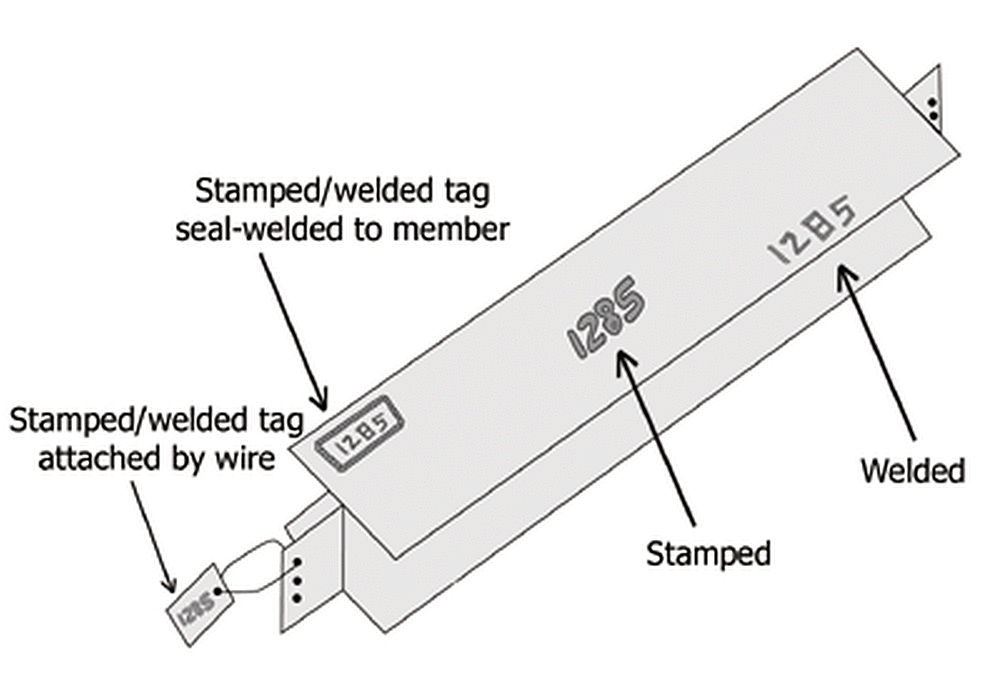
Traceability is a core requirement in aerospace manufacturing. Aerospace traceability marking solutions ensure that every component is uniquely identifiable and linked to production and inspection data.
These systems support compliance, improve visibility, and reduce the risk of traceability gaps during audits.
Traceability Capabilities
- Unique identification assigned to each component
- Integration with inspection and certification records
- Real-time tracking across production stages
- Audit-ready documentation for compliance checks
- Alignment with customer and regulatory requirements
- Improved supply chain transparency
These aerospace traceability marking solutions strengthen compliance and operational control.
Why Frigate for AS9100 Aerospace Part Marking Services
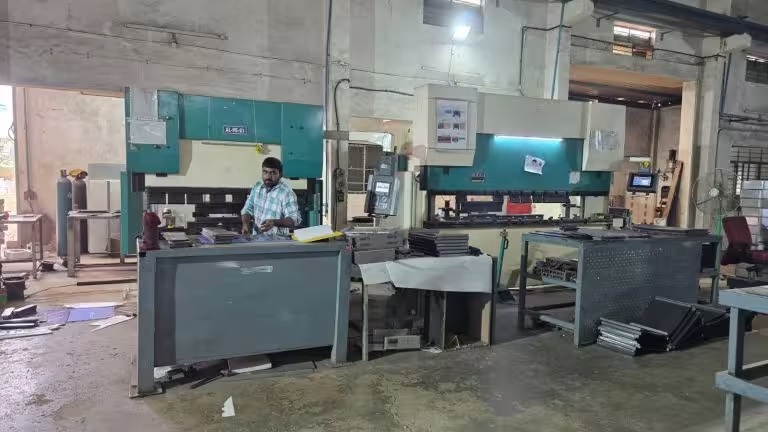
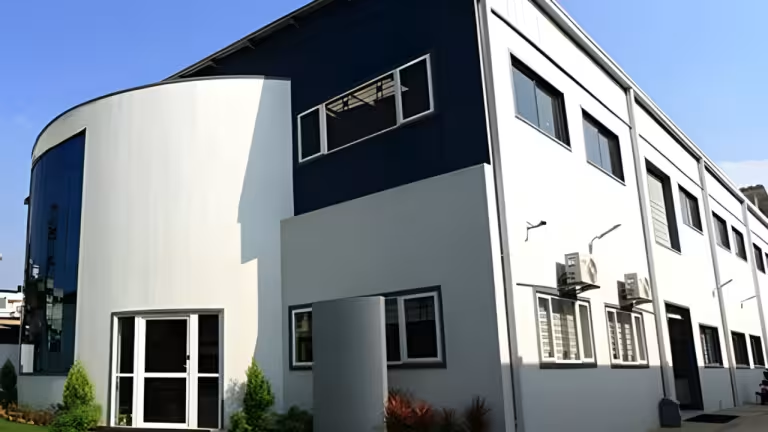
Frigate delivers AS9100 aerospace part marking services as a fully integrated manufacturing capability, ensuring complete alignment between machining, marking, and inspection processes. This alignment allows marking to be executed with precision, consistency, and full process visibility across aerospace production programs.
Manufacturing Integration and Process Control
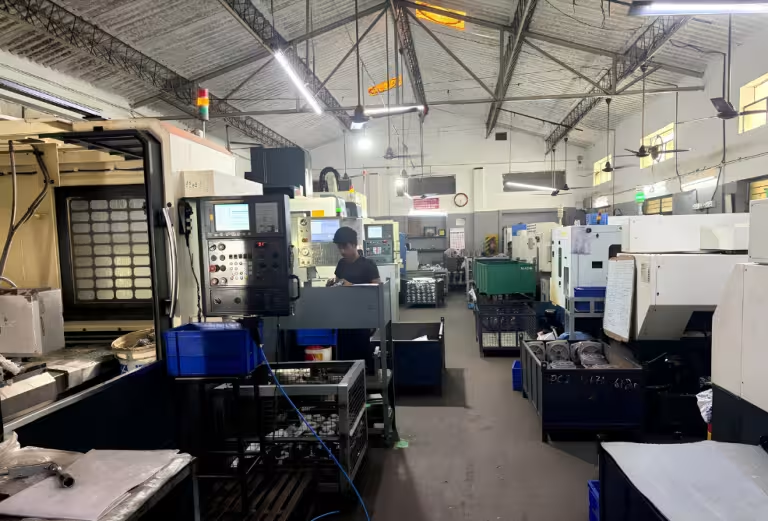
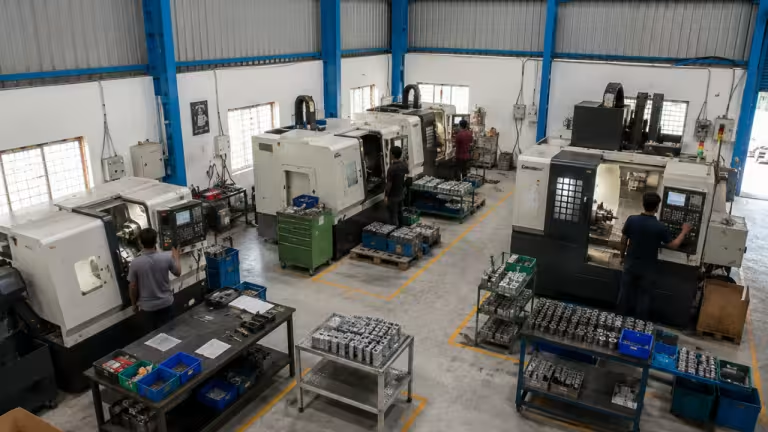
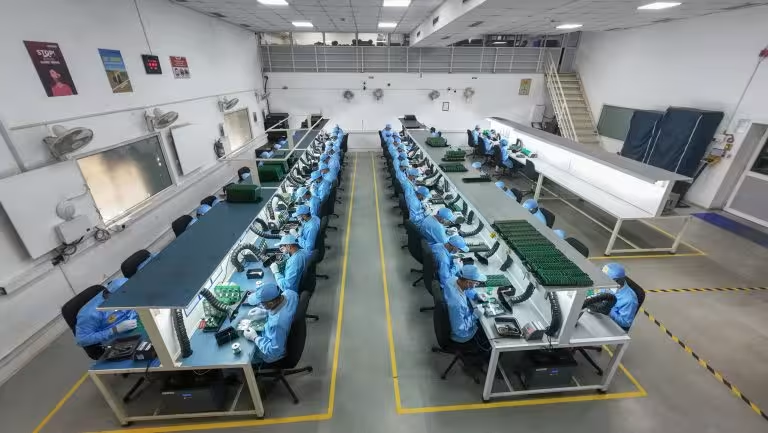
Marking is executed within the same controlled production environment as machining, ensuring that both processes operate with shared references and standards. This integration minimizes variation and ensures that marking placement and quality are directly aligned with part geometry.
- Machining and marking follow unified process planning, ensuring correct placement and orientation
- Marking parameters are defined alongside machining strategies to maintain dimensional accuracy
- Reduced part movement between operations lowers the risk of handling errors or misidentification
AS9100-Aligned Quality Systems
All marking operations are governed by structured quality systems aligned with AS9100 requirements, ensuring compliance across every stage of production. This approach ensures that marking is not only applied correctly but also validated and documented.
- Process documentation ensures traceability and audit readiness
- Inspection checkpoints verify marking quality before part release
- Standardized procedures maintain consistency across different production batches
Capability Across Aerospace Materials and Complex Geometries
Aerospace components often involve advanced materials and intricate designs that require controlled marking processes. Marking systems are configured to adapt to these complexities without affecting part integrity.
- Marking parameters are adjusted based on material characteristics such as titanium, aluminum, and superalloys
- Complex geometries are handled with precision placement to ensure readability and compliance
- Controlled marking depth and energy input prevent structural or surface damage
Scalable Manufacturing Infrastructure
Production requirements vary across aerospace programs, from small batches to high-volume manufacturing. Infrastructure is designed to support these variations while maintaining consistent marking quality.
- Flexible production capacity supports both prototype and large-scale programs
- Automated marking systems ensure uniform output across increasing volumes
- Stable process control ensures that scaling does not introduce variability
Consistent Marking Quality Across Production
Consistency is essential to ensure traceability and compliance. Marking processes are standardized and monitored to deliver uniform results across all components.
- Repeatable parameter settings ensure identical marking across batches
- Continuous inspection ensures clarity, contrast, and readability
- Process controls maintain uniformity across multiple production lines
Reduced Dependency on External Processes
Complete control over marking operations within the manufacturing environment eliminates reliance on external vendors, improving both efficiency and reliability.
- Direct coordination between machining and marking reduces delays
- Elimination of external handling reduces the risk of part mix-ups
- Improved scheduling control ensures timely delivery and process continuity
Manufacturing-Driven Execution for Reliable Outcomes
This manufacturing-focused approach ensures that AS9100 aerospace part marking services deliver predictable, high-quality, and audit-ready results. Each marking operation is executed with precision, aligned with production workflows, and validated through quality systems to support aerospace compliance and traceability.
Conclusion
Frigate delivers AS9100 aerospace part marking services with a strong focus on manufacturing integration, compliance, and process control. Every marking operation is aligned with machining, inspection, and documentation workflows to ensure accuracy, consistency, and full traceability across aerospace components.
Advanced capabilities in aerospace traceability marking solutions support reliable identification, audit readiness, and seamless integration with production systems, enabling consistent performance across complex aerospace manufacturing programs.
Connect with Frigate to discuss your project requirements and implement marking solutions that align with your production, compliance, and traceability goals.