




Robotics control systems are becoming more compact and more powerful each year. Modern control panels handle motion control, real-time communication, power management, and safety circuits within limited cabinet space. Automation density has increased by nearly 60% over the last decade across industrial facilities. More devices are being installed inside the same enclosure footprint.
More components require more wiring. More wiring increases congestion, heat buildup, and maintenance complexity.
Electrical failures linked to wiring contribute to nearly 25% of unplanned downtime events in automated environments. Poor routing blocks airflow, increases electromagnetic interference, and creates mechanical stress at connection points.
Careful cable architecture helps prevent these problems. Flat Cables for Robotics Control Panels offer structured routing, predictable electrical behavior, and strong mechanical durability. Their parallel conductor design supports compact layouts while maintaining signal stability and thermal efficiency.
This blog explains how Flat Cables for Robotics Control Panels address key technical challenges in robotics control environments, while keeping the explanation clear and easy to understand.
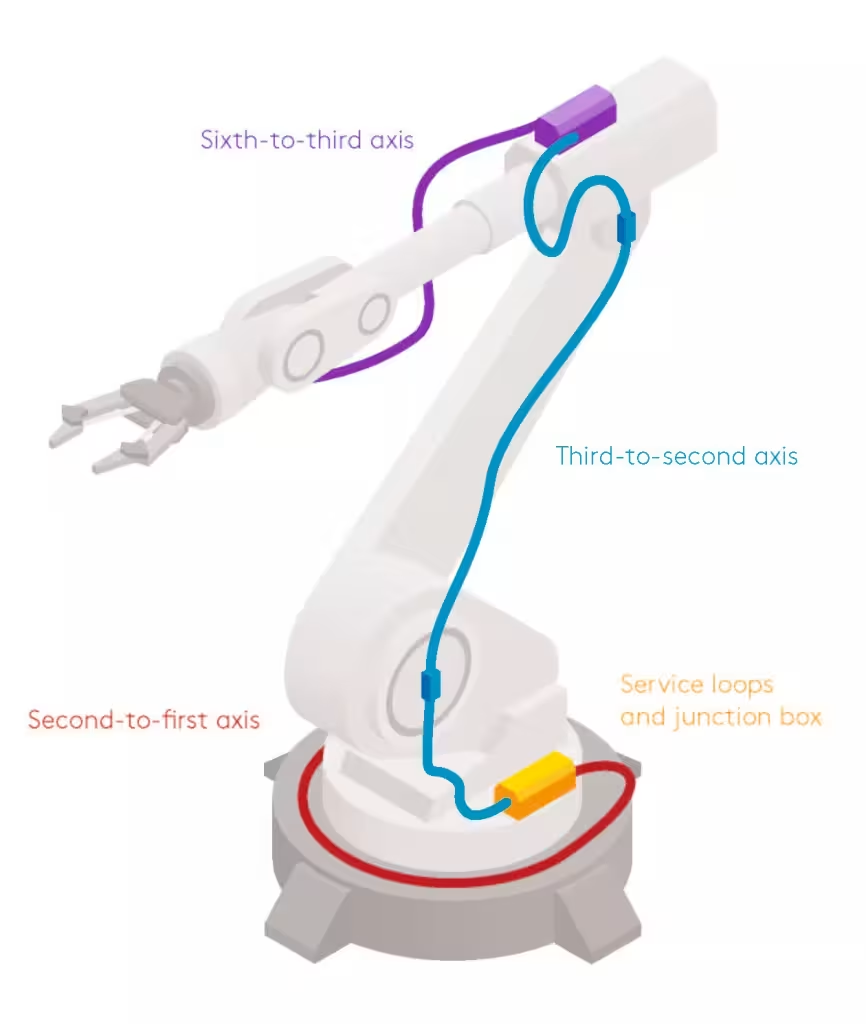
Why Do Robotics Control Panels Require Smarter Space Optimization?
Robotics control panels are no longer simple electrical cabinets. Each enclosure may include PLC systems, servo drives, safety relays, power supplies, communication modules, and interface devices. Every device needs power and signal wiring.
Traditional round cable bundles create thick harnesses. These harnesses reduce airflow and increase internal cabinet temperature. Research shows that for every 10°C increase above optimal temperature, electronic component life expectancy can drop by nearly 50%.
Cable congestion also creates –
- Airflow blockage that traps heat
- Mechanical pressure on connectors
- Difficulty in tracing circuits
- Higher installation errors
- Limited room for future upgrades
Flat Cables for Robotics Control Panels solve these issues through their flat geometry. Conductors are arranged side by side in a uniform structure. This structure allows cables to be routed cleanly along cabinet walls or stacked in organized layers.
Benefits of space optimization include –
- Improved ventilation between cable layers
- Reduced panel depth requirements
- Clear separation between power and signal circuits
- Better visual inspection access
Compact cable management improves reliability and makes system maintenance easier.
How Does Parallel Conductor Design Improve Electrical Performance?
Electrical performance directly affects robotic accuracy. Motion control systems depend on clean and stable signals. Even small electrical disturbances can affect servo positioning and communication timing.
Parallel conductor alignment inside Flat Cables for Robotics Control Panels ensures consistent spacing between conductors. Equal spacing provides stable impedance across the entire cable length.
Key electrical advantages include –
- Controlled impedance for high-speed communication
- Reduced crosstalk between adjacent conductors
- Lower inductive interference
- Better electromagnetic compatibility
- Stable voltage distribution across power lines
Robotics panels often run industrial communication networks such as EtherCAT, PROFINET, and Ethernet/IP. These networks require minimal signal distortion.
Shielded versions of Flat Cables for Robotics Control Panels provide additional EMI protection. Power lines and signal lines often operate close together inside compact panels. Shielding prevents electrical noise from disturbing sensitive data transmission.
Consistent signal integrity ensures accurate motion control and stable automation performance.
How Do Flat Cables Simplify Routing and Panel Layout?
Cable routing affects installation speed and long-term maintainability. Round cable bundles are bulky and difficult to organize. Flat cable design allows structured routing strategies.
Common routing techniques include –
- Layered horizontal stacking
- Routing along vertical panel surfaces
- Separation of high-voltage and low-voltage layers
- Defined bend paths with controlled radius
- Integration into narrow cable trays
Flat cable flexibility supports tight bend radii without stressing internal conductors. Mechanical stress distributes evenly across the cable width.
Installation teams often experience up to 30% faster assembly time when using Flat Cables for Robotics Control Panels compared to bundled round cables. Fewer cable ties and less harness preparation are required.
Maintenance also becomes simpler. Organized layouts allow technicians to identify circuits visually without dismantling entire bundles. Faster troubleshooting reduces production interruptions.
Structured routing also supports modular expansion. Additional circuits can be integrated without disturbing the existing layout.
Why Is Mechanical Durability Critical in Robotics Applications?
Robotics systems operate in high-motion and high-vibration environments. Drag chains move continuously. Robotic arms flex cables thousands of times per day. Temperature fluctuations and industrial contaminants add further stress.
Cable fatigue remains one of the leading causes of automation downtime. Approximately 20–25% of robotic failures are linked to wiring degradation.
High-quality Flat Cables for Robotics Control Panels are engineered for durability through material selection and structural design.
Durability features typically include –
- High-strand copper conductors for flexibility
- Abrasion-resistant insulation such as PVC, TPE, or TPU
- Reinforced outer jackets
- Wide temperature operating range
- Optional shielding for noise-heavy environments
Flat cable geometry distributes bending stress evenly. Twisting forces are minimized because conductors remain aligned. Reduced internal friction increases service life.
Improved mechanical reliability reduces replacement frequency and improves system uptime.
How Do Flat Cables Reduce Total Cost of Ownership?
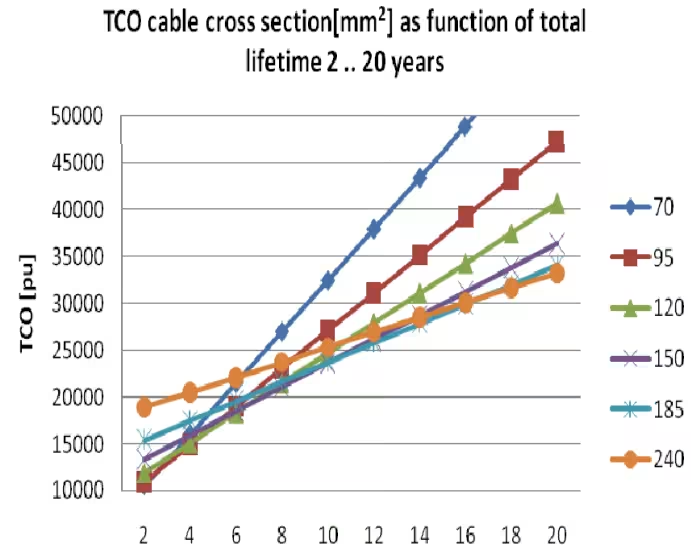
Initial purchase price does not represent total lifecycle cost. Long-term maintenance, downtime, and labor expenses define overall value.
Evaluation of Flat Cables for Robotics Control Panels shows measurable economic benefits –
- Shorter installation time
- Lower labor costs
- Faster fault identification
- Reduced cable replacement frequency
- Simplified inventory management
Clear routing reduces mean time to repair. Maintenance teams can quickly locate faults. Downtime in automated manufacturing environments can cost thousands of dollars per hour. Reduced wiring failures directly lower operational losses.
Compact layouts may also allow smaller cabinet designs. Smaller enclosures reduce material costs and floor space requirements.
Lifecycle savings accumulate over years of operation, making flat cable systems financially efficient in robotics applications.
What Should Be Considered When Customizing and Sourcing Flat Cables?
Robotics applications differ across industries. Automotive assembly, electronics manufacturing, and pharmaceutical automation each have unique cable requirements.
Customization options for Flat Cables for Robotics Control Panels may include –
- Variable conductor counts
- Custom pitch spacing
- Integrated shielding
- Specific insulation compounds
- Compliance with UL and RoHS standards
Consistency across production batches is critical. Variations in conductor alignment can affect impedance and durability.
Reliable suppliers implement strict quality control processes such as –
- Dimensional inspection of conductor placement
- Electrical continuity testing
- Flex cycle testing
- Thermal and environmental validation
Supply chain stability also matters. Delays in cable delivery can postpone equipment shipment. Dependable manufacturing partnerships reduce scheduling risk.
Scalable production capacity supports both prototype development and full-scale manufacturing.
How Does Frigate Deliver Reliable Flat Cable Solutions for Robotics Control Panels?
Frigate develops Flat Cables for Robotics Control Panels using a structured engineering and manufacturing approach. Robotics control environments demand compact routing, stable signal transmission, and long mechanical life. Reliability is achieved through precision design, strict quality control, and application-focused customization.
Precision Conductor Engineering for Electrical Stability
Electrical performance starts with accurate conductor geometry. Conductor spacing affects impedance, signal timing, and overall transmission quality.
Frigate ensures –
- Tight tolerance control of conductor pitch
- Uniform copper strand distribution
- Balanced insulation thickness
- Consistent flat cable lamination
Uniform alignment maintains stable impedance across the cable length. This supports high-speed communication protocols and reduces signal reflection. Parallel conductor layout also minimizes crosstalk inside dense panels.
Advanced Mechanical Design for High-Flex Applications
Robotics systems operate under continuous motion. Cable fatigue can cause unexpected downtime.
Frigate designs Flat Cables for Robotics Control Panels with –
- High-strand-count copper for flexibility
- Abrasion-resistant insulation materials
- Validated bend radius performance
- Reinforced bonding for structural stability
Flex-cycle testing simulates real operating conditions. Even stress distribution across the flat structure improves durability in drag chain and robotic arm applications.
Shielding Integration for EMI-Sensitive Environments
Electrical noise can interfere with signal transmission in compact panels. Shielded flat cables reduce this risk.
Design focus includes –
- Consistent shielding coverage
- Reliable grounding continuity
- Separation of power and signal conductors
- Shield performance validation
Effective EMI control ensures stable communication and precise robotic motion.
Custom Configuration to Match Application Requirements
Robotics systems often require specific cable configurations. Standard designs may not fit space or performance needs.
Frigate offers –
- Custom conductor counts
- Adjustable pitch spacing
- Hybrid power and signal layouts
- Compliance with UL and RoHS standards
Customized arrangements improve routing efficiency and electrical stability.
Controlled Manufacturing for Dimensional Accuracy
Consistency across production batches is essential for performance reliability.
Frigate maintains quality through –
- Calibrated extrusion and lamination processes
- Continuous dimensional inspection
- Electrical resistance and continuity testing
- High-voltage and impedance validation
Strict process control ensures repeatable electrical and mechanical performance.
Engineering Collaboration During the Design Phase
Early design input reduces routing challenges later in the project.
Frigate supports –
- Bend radius evaluation
- Space optimization planning
- Connector compatibility review
- Airflow and layout assessment
Proactive collaboration improves long-term panel reliability and serviceability.
Scalable Production for Prototype to High-Volume Programs
Robotics projects often scale quickly from development to mass production.
Frigate provides –
- Small-batch prototype capability
- Rapid design adjustments
- High-volume manufacturing capacity
- Stable supply chain support
Scalable production ensures reliable delivery without compromising quality.
Conclusion
Robotics control panels require compact layouts, reliable signal transmission, and durable mechanical performance. Cable architecture directly influences system stability and operational efficiency.
Flat Cables for Robotics Control Panels enable organized routing, improved airflow, stable electrical performance, and long service life. Parallel conductor geometry reduces congestion while supporting high-speed communication and continuous motion.
Connect with Frigate to explore customized flat cable solutions that enhance performance, reliability, and long-term efficiency in robotics control systems.